

The Quiet Art of Gliding Effortlessly Underwater
There is a particular calm in hovering motionless over a clear tropical reef, with the water carrying your weight and the sea floor resting safely below. The best dives often have this quality: no frantic kicking, no sculling hands, no constant adjustment of the inflator. Instead, the diver moves with the easy rhythm of a visiting ray. When trim is poor, that same dive can feel entirely different. Legs drop, the body rises at an angle, the fins work continuously, and breathing becomes noticeably heavier. A simple reef swim can turn into an exhausting uphill journey.
Pristine buoyancy is rarely achieved simply by removing more lead. The more important task is arranging the diver and equipment so the center of gravity and center of buoyancy cooperate rather than compete. A cylinder set too low, dense fins, trapped air in a suit, or weight placed far from the body can create a subtle rotational force. Even a modest head-up or head-down angle increases the amount of water pushed aside with every movement. A well-balanced Abaco scuba experience becomes noticeably more comfortable when the body forms a clean horizontal line, leaving breathing, awareness, and gentle propulsion to do the work instead of brute force.
Understanding the Physics of Center of Gravity and Center of Buoyancy
Your center of gravity, or CofG, is the point through which the combined downward force of your body, cylinder, ballast, and other equipment acts. Your center of buoyancy, or CofB, is the point through which the upward force from displaced water acts. These are not fixed points. They change as your lungs fill and empty, as gas moves through a buoyancy compensator, and as exposure protection compresses with depth. Nevertheless, treating them as two practical reference points gives you a useful way to understand trim.
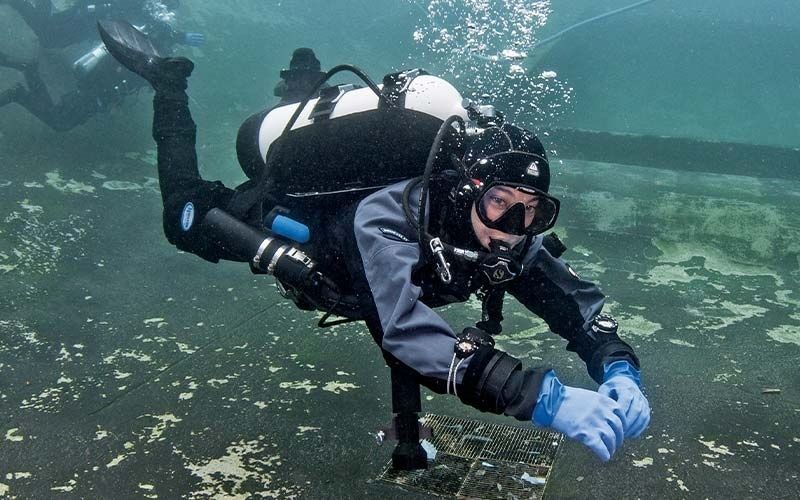
When the CofG and CofB are vertically separated, the two forces create torque. The diver rotates until the forces line up or until muscular effort and fin movement stop the rotation. A low CofG beneath a higher CofB can pull the feet downward. The reverse arrangement can dump the head forward and raise the legs. The effect may be gentle, but it is persistent. A diver can appear to hold a flat position while constantly making small corrections that are difficult to notice from inside the suit.
This internal rotational seesaw is costly because the body must act as a stabilizing structure. Lower back muscles tighten to lift the legs, abdominal muscles brace to stop the torso from pitching, and the hips and knees remain engaged instead of relaxed. Breathing can also influence the balance. Inhalation shifts buoyancy toward the chest and head, while exhalation shifts it toward the feet. A properly configured rig allows these natural changes to produce a controlled rise and fall rather than a pronounced rocking motion.
- CofG: the combined downward pivot point of the diver and equipment.
- CofB: the combined upward lifting point created by displaced water.
- Separation: the distance between them that creates rotational torque.
- Trim: the body angle that allows the diver to move with minimal correction and drag.
How a Subtle Angle Drains Your Tank and Taxes Your Heart
Water is dense, and it resists any object that presents a broad frontal surface. A diver lying nearly horizontal presents a narrow, streamlined profile. A diver tilted upward presents the chest, cylinder, hips, and thighs to the flow. The difference can be felt even when the angle appears minor. A fifteen-degree tilt does not literally double resistance in every real-world diving situation, because drag depends on speed, equipment shape, flow, and body position. However, the frontal area can increase sharply enough that the practical effect feels disproportionate, especially during steady swimming against current.
Consider the way the body behaves when the legs sink. Each kick must first lift the lower body before it moves the diver forward. If the diver responds by kicking harder, the result is greater turbulence and faster breathing, not necessarily better progress. The cycle is familiar: poor trim creates drag, drag demands effort, effort raises respiratory demand, and increased breathing changes buoyancy and makes trim harder to hold. On a warm reef, even a light current can expose this inefficiency within minutes.
| Body position | Hydrodynamic effect | Typical diver response |
|---|---|---|
| Nearly horizontal | Small frontal profile and smoother water flow | Gentle frog kicks and relaxed breathing |
| Moderately angled | Greater chest, hip, and leg exposure to the water | More frequent finning and frequent buoyancy corrections |
| Strongly head-up or head-down | High drag, turbulence, and inefficient propulsion | Heavy breathing, muscle tension, and rapid gas use |
The cardiovascular cost is not limited to the muscles moving the fins. Continuous swimming against a tilted buoyancy profile requires sustained work from the legs, trunk, and respiratory system. Immersion, cold, exertion, and the work of breathing already place demands on a diver. Research from the DAN VRAK expedition study found transient cardiopulmonary changes among divers completing repeated cold-water rebreather dives. That study involved a specialized CCR environment rather than ordinary recreational open-circuit diving, but it reinforces a sensible principle: unnecessary physical workload should not be added through avoidable drag and poor equipment balance.
Dialing in Your Rig for Neutral Horizontal Poise
Equipment adjustment should begin with the smallest practical change, made one variable at a time. Ballast belongs close to the body whenever possible, but its position along the diver”s length affects trim. Integrated waist pockets, harness trim pockets, tank-mounted weight systems, backplates, and small upper or lower attachment points can all shift the axis. Moving a small amount of weight toward the shoulders can help a foot-heavy diver, while lower placement may assist a diver whose head drops. Changes should be modest because a few pounds placed far from the torso can create more leverage than expected.
The cylinder is another major trim control. A tank positioned too low can make the feet heavy, while one mounted too high can create a head-heavy tendency, depending on the cylinder”s buoyancy characteristics and the rest of the rig. Adjust the BCD cam band incrementally and confirm that the cylinder remains secure. Never sacrifice proper cylinder retention for trim. A well-balanced configuration also needs to remain comfortable on the surface, stable during entry and exit, and compatible with the diver”s training and equipment procedures.
Do not overlook fins and exposure protection. Dense rubber fins can lower the feet in a way that is useful for some configurations and troublesome for others. Thick wetsuits provide more buoyancy around the legs and torso near the surface, then compress with depth, changing the balance during the descent. Drysuit gas can migrate toward the feet if the diver”s position or suit fit encourages it. A diver who seems perfectly trimmed at the beginning of a dive may therefore become slightly feet-heavy later. Treat the configuration as a complete system rather than trying to correct every issue with additional lead.
- Check whether the imbalance remains after the BCD is fully vented and the suit gas is distributed correctly.
- Move only one small weight or one attachment point at a time.
- Test cylinder height before changing several ballast locations.
- Assess fin density, wetsuit thickness, and gas migration as part of the same diagnosis.
- Confirm the new arrangement in both salt water and fresh water if both environments are part of your diving.
Actionable Water Drills to Calibrate Your Balance
Begin in a calm, shallow area or during a controlled safety stop where the bottom is not vulnerable to contact. Establish neutral buoyancy, vent excess gas, and allow the limbs to relax. The purpose is not to pose rigidly but to observe what the equipment does when the diver stops correcting it. If the feet sink, the head rises, or the body rolls consistently, the rig is offering useful information. Repeatedly forcing the body flat only hides the underlying torque.
Once the balance is understood, practice a bent-knee horizontal platform. Keep the thighs in line with the torso, bend the knees so the fins remain clear of the reef, and use small frog kicks that send water backward without sweeping the bottom. Hands should remain still whenever possible. Sculling can disguise poor trim because the arms become an emergency stabilizer. A relaxed hover followed by a controlled kick gives a much clearer picture of whether the equipment is balanced.
- Settle: become neutrally buoyant, stop finning, empty unnecessary gas from the BCD, and let the body reach its natural resting angle.
- Observe: note whether the head, shoulders, hips, or feet consistently drop, rise, or roll.
- Isolate: change one factor only, such as cylinder height, a small trim weight, or the distribution of suit gas.
- Retest: repeat the hover, then add a gentle frog kick and a stop to confirm that the improvement works during movement.
During an island dive, this checklist fits neatly into a calm shallow reef entry or a safety stop in open water. Keep the surroundings in mind, particularly over coral heads, sandy patches, and areas with surge. Good trim is not only an air-consumption technique. It is a form of environmental courtesy. A diver who can pause without touching the bottom has more time to notice a cleaner passage, avoid a delicate fan, and allow a turtle or school of fish to continue undisturbed.
Glide with Ocean Ease on Every Descent
Efficient buoyancy comes from a series of small, deliberate decisions. A cylinder moved a few centimeters, a trim weight relocated to a more useful point, or a change in fin selection can reduce the torque that has been making the body work all dive. Once the center of gravity and center of buoyancy are better aligned, propulsion becomes quieter, breathing settles, and the tank lasts longer because less energy is spent pushing unnecessary surface area through the water.
The reward is more than improved gas efficiency. True horizontal balance brings a mental stillness that makes navigation, photography, buddy awareness, and reef observation easier. Treat trim as an evolving personal craft rather than an overnight achievement. Exposure protection, cylinders, salt water, fresh water, and changing gas volumes will all influence the result. With patient testing and a few calm checks on every dive, the sea can begin to feel less like something to swim through and more like a place that gently carries you.