
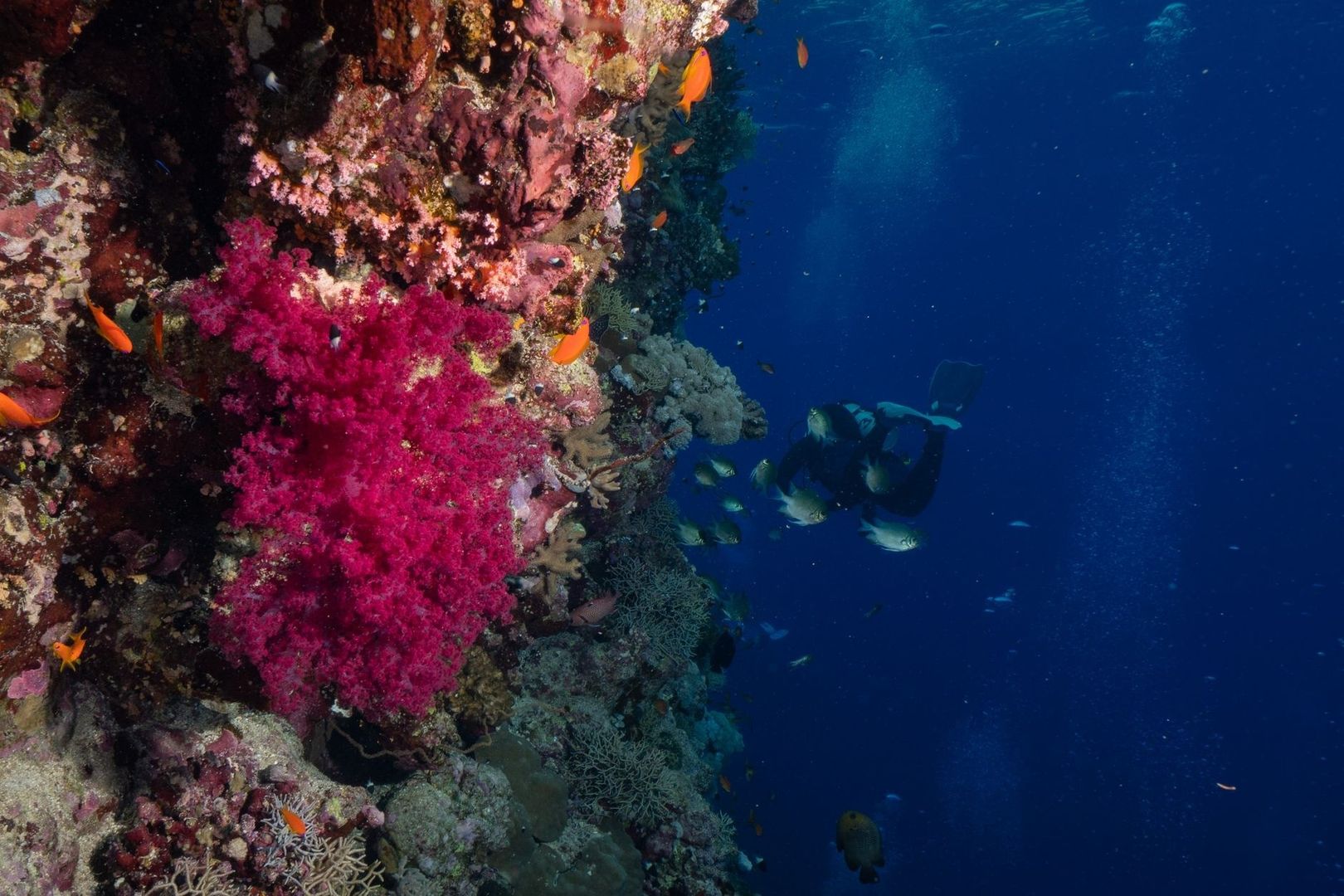
Embracing the Sheer Edge of the Atlantic Wall
A vertical wall dive offers one of the sea”s most distinctive sensations. The reef crest may begin in familiar, sunlit shallows, then fall away so cleanly that the eye seems to lose its usual reference points. Beyond the lip is open blue, spacious and quiet, with the wall descending through changing shades of water. For a properly prepared diver, that apparent bottomlessness is not a threat. It is simply a different landscape, one where position, depth, and movement must be read through instruments, the reef profile, and the behavior of the water.
The visual drama can be softened by remembering that the ocean is not suddenly empty at the edge. Horizontal swells and currents continue to move across the reef, but a sheer substrate redirects some of that flow. Water may rise along one section, sink beside a buttress, or accelerate around a corner. These shifts create the lively conditions that bring plankton, schooling fish, rays, and other pelagic visitors to exposed walls. The goal is not to overpower those movements. It is to recognize them early, maintain calm buoyancy, and let the wall become a reliable coastal landmark in the blue.
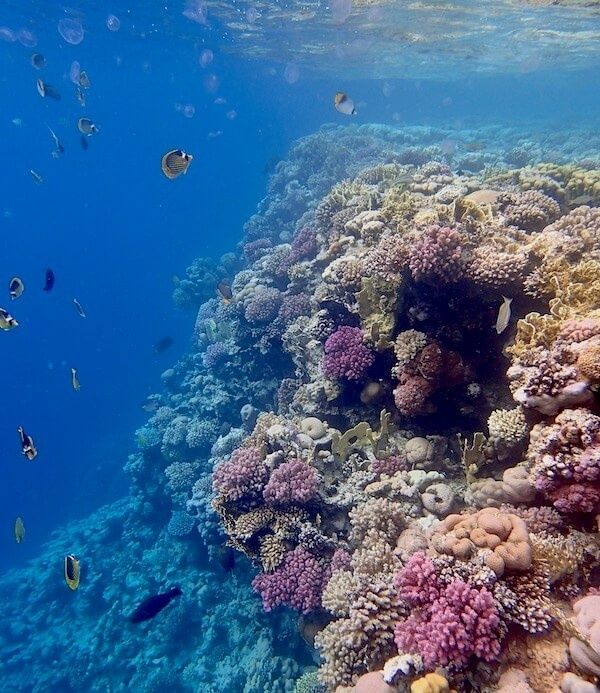
The Fluid Mechanics of Vertical Topography
When an ocean current meets a sloping reef, much of its energy can continue across the bottom. A near-vertical wall changes that relationship. Water approaching the face must be diverted, and the flow may turn upward, downward, or sideways depending on the current”s direction, the wall”s height, nearby channels, and the shape of the seabed. Around a projecting buttress, water can speed up. In the lee of an outcrop, a quieter eddy may form. At a corner, separate flows can converge and produce turbulence that is noticeable even when the wider sea appears calm.
Some of the most productive water movement occurs when deeper, cooler water is lifted toward a reef face or shelf edge. This process can carry nutrients into shallower layers, supporting plankton and the food chain that follows. A diver may experience the result as a sudden temperature change, a gentle upward push, or a patch of water with noticeably different visibility. Such movement does not automatically indicate dangerous conditions, but it does call for closer depth monitoring and a willingness to move a short distance away from the strongest flow.
The larger oceanographic picture is equally useful. In boundary-current systems, mixing along shelves and upper slopes can transport material away from the seabed and redistribute it through the water column. A modeling study of sediment-derived iron in an eastern boundary upwelling system described how a bottom boundary layer can thicken and move offshore when circulation changes, carrying dissolved material beyond the shelf. The full process is far larger and slower than anything a diver directly observes, but it illustrates why underwater topography matters to ocean transport. The research is available in this ocean transport study. A wall is not merely a scenic drop. It is part of a three-dimensional boundary where water, nutrients, larvae, and sediment can be redistributed.
Recognizing Current Dynamics Before and During the Descent
Good wall diving begins before entering the water. On the surface, look for the direction of wind-driven texture, the movement of foam or floating debris, and any difference between the water above the reef and the water beyond the edge. A site briefing should establish the intended depth, entry and exit plan, expected current direction, buddy procedures, and the method for signaling the surface. Conditions can change with depth, so a calm surface does not guarantee still water at the wall.
Underwater, small details become useful instruments. Soft corals leaning consistently in one direction, suspended particles streaming past the reef, schooling fish holding position, and bubbles moving laterally rather than rising straight up all reveal flow. A sudden thermocline may feel like a cool curtain across the body, while an upwelling can make the wall seem to move downward as the diver is gently lifted. Upwelling is a natural circulation process in which deeper, colder, nutrient-rich water rises toward the surface, as explained by this NOAA upwelling overview. It can enrich reef life while also demanding careful buoyancy control.
| Observation | Likely hydrodynamic state | Useful response |
|---|---|---|
| Corals and particles stream in one direction | Steady lateral current | Adopt a streamlined trim and drift with the flow |
| Particles rise along the wall and bubbles accelerate upward | Localized upwelling | Monitor depth, vent gas gradually, and move laterally if needed |
| Particles descend and the wall appears to slide upward | Possible downwelling | Remain calm, add controlled lift only if trained and necessary, and move away from the strongest flow |
| Water is calm behind a projection but fast around its tip | Eddy or flow acceleration | Use the sheltered side for observation and avoid the exposed corner |
| Fish face into the current and hold position | Persistent flow bringing food | Expect movement and conserve energy by avoiding a fight against the current |
Mastering Neutral Buoyancy in Blue Water Space
On a shallow reef, the bottom provides a reassuring visual reference. Along a wall, that reference may be several hundred feet below, outside the dive plan, or invisible in blue water. Depth becomes the primary reference, supported by the computer, pressure gauge, buddy position, and the wall”s contours. Check the depth display regularly rather than waiting for a visual reminder. A diver who drifts only a few feet deeper while distracted by marine life can increase gas consumption and nitrogen exposure without noticing the change.
Breathing is one of the finest buoyancy controls available, but it works best when used early and gently. A slow, relaxed inhalation produces a small lift; a longer, controlled exhalation reduces it. If an upwelling carries you upward, avoid rapid, repeated breathing or frantic finning. First reduce movement, confirm depth, and make small adjustments to the buoyancy compensator only when needed. In a downwelling, do not dump gas indiscriminately or make a panicked ascent. Follow training, maintain contact with the buddy, and move horizontally away from the strongest vertical flow while monitoring depth and gas.
A horizontal body position also makes the dive easier. Keep the torso level, knees slightly bent, and hoses, gauges, and alternate air source secured close to the body. Streamlining reduces drag and prevents equipment from catching on coral or projecting rock. The following habits are especially valuable:
- Use small fin movements from the hips rather than large bicycle kicks.
- Keep a consistent distance from the wall without touching living organisms.
- Check depth, time, pressure, and no-decompression status at regular intervals.
- Use the wall as a visual guide, not as a handhold or a surface to rest against.
- Signal early if buoyancy, gas supply, visibility, or current strength becomes uncomfortable.
A Practical Protocol for Effortless Wall Exploration
The safest position is rarely the most exposed one. A diver who remains directly in the strongest flow may spend gas and energy simply holding station. The wall”s contours offer a series of small decisions: stay on the sheltered side of a buttress, avoid the outer tip of a pinnacle when the current is accelerating, and use a shallow recess for a brief observation stop. The right position can change as the reef turns, so navigation should be active rather than automatic.
If the current carries you outward, the first response should be calm assessment. Confirm depth and buddy location, streamline the body, and avoid swimming directly against a strong flow. Depending on the site plan and training, swimming diagonally across the current toward the wall may be more effective than heading straight into it. If returning to the wall is not practical, a controlled drift may be safer, provided the buddy remains together and the surface support plan is followed. A delayed surface marker buoy, signaling device, and alternative air source are important parts of preparation, not substitutes for a briefing or sound judgment.
- Review the wall profile, planned maximum depth, current direction, gas minimum, turnaround point, and exit procedure before entry.
- Descend in a controlled manner while confirming the computer, pressure gauge, buddy position, and the first section of wall.
- Settle into horizontal trim on the sheltered side of the reef, then observe particles, corals, fish, and bubbles to establish the flow direction.
- Travel with the current where appropriate, making modest depth corrections and checking instruments before the wall disappears from view.
- Use overhangs, buttresses, and natural recesses as brief rest points only when they are clear of fragile life and do not trap the diver in changing flow.
- If caught in an upwelling or downwelling, reduce finning, protect depth limits, communicate with the buddy, and move laterally toward gentler water when possible.
- Begin the planned ascent and safety stop with adequate separation from the wall, allowing room for buoyancy changes and other divers.
Overhangs and chutes deserve particular respect. They can provide shelter from lateral flow, but they can also funnel water and create a stronger jet at an exit. Enter only when the route is clear, the buddy can follow, and the dive team has agreed on the plan. A natural feature should function as a temporary observation point, not an improvised anchor. Avoid grabbing coral, wedging into a crevice, or kicking sediment from the wall, since even a small disturbance can damage slow-growing organisms and reduce visibility for everyone behind.
Gliding Confidently into the Open Blue
Wall currents are not random obstacles scattered across an otherwise motionless sea. They are pathways shaped by cliffs, shelves, corners, canyons, and changing water layers. Those pathways deliver food and oxygen, concentrate marine life, and give a skilled diver a natural route through the site. Once the movement is read, the dive often becomes quieter and more efficient. The wall remains close enough to guide navigation, while the current supplies much of the forward travel.
The essential preparation is straightforward: plan the depth and gas carefully, watch the water before committing to the descent, stay streamlined, and respond to vertical movement with small, deliberate corrections. Respect for the wall means respecting both its living surface and its changing hydrodynamics. With calm observation, reliable buddy communication, and fine-tuned buoyancy, the edge of the reef becomes less an intimidating drop and more an open invitation to explore the blue with control.