

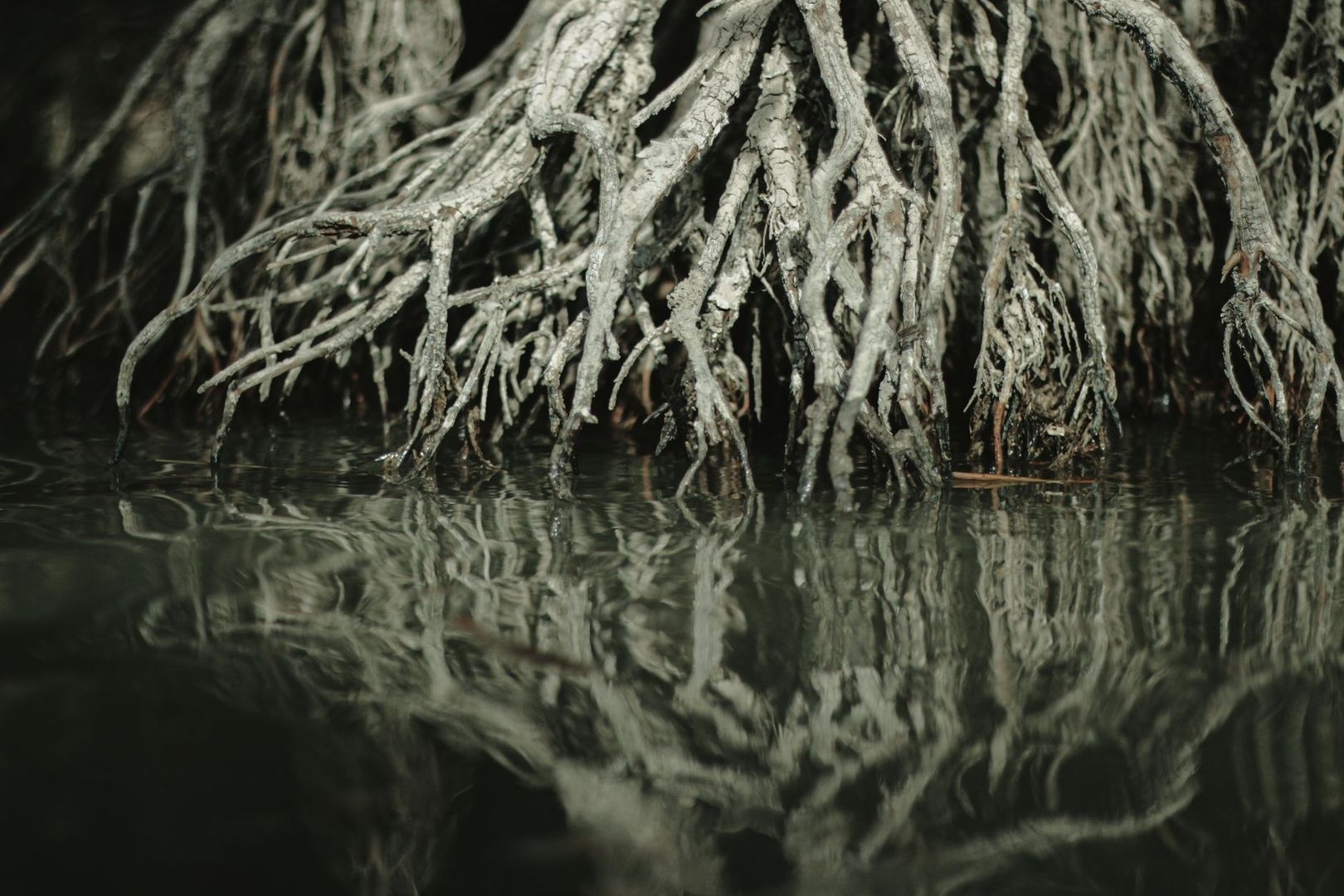
Gliding into the Amber Shallows of the Coastal Mangrove Fringe
At first light, a mangrove creek can look almost still. Tannin-stained water catches the morning sun in amber ribbons, while the breeze moves softly through leathery green leaves above the tide line. From a kayak, stand-up paddleboard, or quiet skiff, the shoreline may appear muddy and unremarkable. Beneath the surface, however, the scene is busy with young fish, grazing invertebrates, algae, sponges, and drifting particles that form the living foundation of a much larger seascape.
Red mangroves are not simply storm buffers or untidy margins between land and sea. Their submerged roots are a nursery, dining room, refuge, and launch point for animals that will later populate Caribbean seagrass beds, patch reefs, and outer reef walls. A healthy coastal system works as a connected continuum. Life begins among the roots, gathers strength in sheltered shallows, and eventually moves toward the open ocean. The journey below follows that progression, from the architecture that creates protection to the careful choices visitors can make while exploring it.
Architecture of the Prop Roots and the Calm Water Sanctuary
The red mangrove, Rhizophora mangle, is especially well suited to the tropical intertidal zone. Its arching prop roots descend from the trunk and branches into soft, oxygen-poor sediment, giving the tree stability where ordinary terrestrial roots would struggle. These roots also interrupt water movement. Instead of allowing waves and currents to pass through as a single force, the tangled structure divides and slows them, reducing turbulence and helping sediment settle.
That calm does not mean an empty habitat. Root surfaces become living platforms for algae, sponges, oysters, barnacles, juvenile bivalves, and other epiphytes. Narrow spaces between the roots offer hiding places for small fish and crustaceans, while the shaded water helps young animals avoid visual detection. The lattice is difficult for large barracudas and open-water sharks to enter, giving juveniles a physical advantage that disappears once they move into deeper, more exposed habitats. Salt tolerance, specialized root systems, and the ability of red mangrove propagules to mature while attached to the parent tree all help these forests persist in demanding conditions.
- Wave reduction slows surge and protects the shallow nursery from sudden turbulence.
- Root complexity creates narrow shelter for juvenile fish, shrimp, crabs, and lobsters.
- Epiphyte growth supplies grazing surfaces and supports a layered food web.
- Filtered water allows sediment and some pollutants to settle before reaching nearby seagrass and reefs.
Detailed coastal surveys described by the National Oceanic and Atmospheric Administration show how a healthy mangrove forest establishes an intricate root system that provides shelter from heavy wave surge and open-water predators. The same habitat also stores carbon, cycles nutrients, stabilizes shorelines, and links directly with coral reefs and seagrass meadows. Its strength is therefore not only in individual trees, but in the connected forest edge.
Key Inhabitants Growing Up in the Estuarine Nursery
The nursery is used by animals at different stages of development, and each resident occupies the roots in a slightly different way. Juvenile schoolmaster snappers and cubera snappers may patrol close to the lattice, darting out to capture tiny amphipods and other small prey before retreating into cover. Their presence is easy to miss because young fish often hold motionless in shadows, then move with surprising speed when food passes nearby.
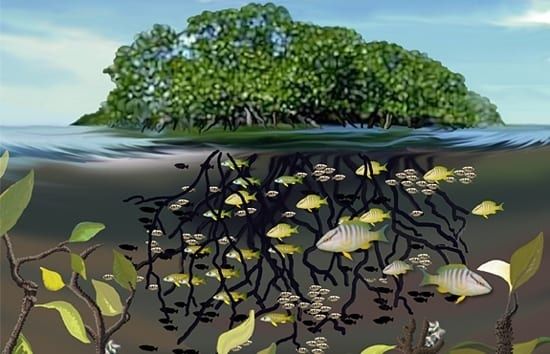
Post-larval spiny lobsters use the structure differently. After arriving in coastal habitat, they can anchor among root fibers and shelter within the complex bottom until they are large enough to occupy seagrass, patch reefs, and eventually deeper reef habitat. Mangroves also support shrimp, grouper, jacks, and other species important to both ecosystems and fisheries. The NOAA conservation guidance for International Mangrove Conservation Day emphasizes that these commercially and recreationally important animals depend on mangrove-associated nursery habitat.
| Nursery resident | Typical stage in the roots | Primary food or shelter use |
|---|---|---|
| Schoolmaster snapper | Juvenile | Hunts amphipods and other small invertebrates among shaded roots |
| Cubera snapper | Juvenile | Uses cavities for cover while taking small crustaceans |
| Spiny lobster | Post-larval and young juvenile | Anchors among root fibers and feeds as it grows |
| Grouper and jacks | Early juvenile stages | Finds shelter and feeding opportunities in quiet creeks |
| Shrimp and small crustaceans | Multiple life stages | Feeds on organic matter and supports larger predators |
These species are not merely visitors passing through a scenic shoreline. For many, the nursery provides the combination of food, low current speed, and predator protection required for survival during their most vulnerable stages. Losing the mangrove edge can therefore reduce the number of animals that later reach nearby reefs, even when the offshore coral structure itself remains intact.
The Great Twilight Migration Across Seagrass to the Outer Barrier
A reef fish does not necessarily spend its entire life in one habitat. Many Caribbean species shift locations as their bodies, diets, and defenses change. Mangrove creeks provide the protected beginning, seagrass meadows offer a productive intermediate corridor, patch reefs add structure and feeding territory, and outer barrier reefs provide deeper habitat for larger juveniles and adults. The value of each zone increases when the connections between them remain open.
Movement may become more noticeable around dusk and during nighttime hours, when some young fish leave root shelter to forage. Darkness reduces visual exposure, while tidal changes can help carry animals through shallow channels. Size and maturity are equally important triggers. A fish that once needed the tightest root cover may later be strong enough to cross a sandy opening, defend a small reef territory, or follow prey into deeper water. Research on fish ecology in the Bahamas and the wider Caribbean has identified mangrove creeks as important nursery grounds for juvenile fish associated with nearby barrier reefs.
- Settlement among the roots occurs when post-larval fish and crustaceans reach sheltered coastal habitat and find suitable cover.
- Early growth in the creek allows juveniles to feed on small crustaceans and other organisms while avoiding larger predators.
- Movement into seagrass begins as animals grow, improve their swimming ability, and require broader feeding grounds.
- Use of patch reefs provides additional shelter, hunting territory, and a transition toward more exposed conditions.
- Colonization of the outer reef follows when size, maturity, tides, and local food availability make deeper habitat suitable.
The crossing between habitats can be surprisingly vulnerable. A young fish moving over an open sandy bottom has little of the physical protection available inside a root maze. Nocturnal travel helps, but it does not remove risks from predatory fish, strong currents, boat traffic, poor water quality, or fragmented shorelines. The corridor must function as a system, not as a collection of isolated attractive places.
Connectivity can also work in both directions. Adult reef fish contribute larvae to coastal areas, while locally produced juveniles may later return to nearby reefs. Studies of fish communities in the Bahamas and U.S. Virgin Islands have examined this relationship through field surveys, experiments, and molecular techniques, including the possibility that local self-recruitment helps maintain nearby populations. For visitors, this is a useful reminder that a quiet creek can influence life far beyond the shoreline visible from a paddleboard.
How Island Explorers Can Mindfully Experience the Tangled Roots
Mangrove creeks are best explored at a relaxed pace. Kayaks and stand-up paddleboards allow visitors to move quietly through narrow waterways, while drift snorkeling can reveal the submerged root habitat where local conditions permit safe entry. Before setting out, check the tide, wind, weather, access rules, and local guidance. A rising or slack tide may provide easier movement through shallow channels, but visibility varies with rainfall, boat wakes, recent wind, and sediment disturbance. Early morning often brings gentler light, calmer conditions, and active fish before the heat of the day.
Keep equipment practical and protective. A high-clarity mask makes it easier to distinguish small fish from root shadows, and a rash guard provides sun protection without requiring heavy sunscreen in the water. Choose reef-conscious sun protection, but remember that no product replaces shade and clothing. The roots can host sharp shells, fire sponges, sea urchins, and stinging organisms, so gloves should not become an excuse to handle the habitat. The safest observation is hands-off, with enough space to avoid contact.
- Paddle slowly and keep a comfortable distance from exposed roots and wildlife.
- Do not anchor, drag boards, or push off against prop roots.
- Avoid kicking the bottom, which can create sediment plumes that reduce visibility and smother delicate surfaces.
- Never collect shells, epiphytes, propagules, or animals from the nursery.
- Keep voices and motor noise low, particularly in narrow creeks.
- Follow local protected-area rules and use established launch points where available.
Careful positioning matters for both safety and science. Field researchers working in mangroves have noted that tides, sediment, boat wakes, sharp organisms, and irregular root structures can make still observation difficult. A visitor who drifts rather than grabs, watches rather than chases, and leaves the water clear for the next observer is helping preserve the very behavior that makes the nursery special.
Protecting the Living Shallows That Sustain Your Deep Blue Reefs
The journey from a red mangrove root to a Caribbean reef wall is an ecological continuum. Roots slow the water, epiphytes and small invertebrates build the food web, juvenile fish and lobsters find shelter, seagrass meadows provide the next corridor, and patch and barrier reefs receive animals ready for more exposed life. Damage at the shoreline can therefore echo offshore through fewer recruits, reduced food-web resilience, and weaker fish populations.
For travelers, conservation begins with attention. Choose guides who respect no-touch practices, keep pollutants out of the water, avoid damaging shallow habitat, and support local restoration or protected-area programs where possible. A muddy fringe may not have the instant drama of a coral wall, but it is where much of that reef life begins. Protecting the quiet shallows is one of the most direct ways to help keep the deep blue healthy.