
Riding the Ocean Express with Purpose and Precision
A fast tidal pass can feel like the ocean has opened a moving lane beneath you. One moment the reef is calm and richly detailed; the next, the water gathers speed, bubbles stream past your mask, and the entire team begins a spectacular flight through blue water. That sensation is part of the appeal, but the best drift dives are not passive rides. They are carefully managed exercises in buoyancy, timing, visibility, communication, and seamanship.
In a high-energy cut, preparation matters as much as certification. Before entering the acceleration zone, every diver should understand the tide, the planned depth range, the pickup arrangement, and the signals that will be used when current masks sound and separates people. A compact finger spool, a properly packed delayed surface marker buoy, and disciplined buddy positioning provide the practical foundation. With those tools and habits in place, turbulent water becomes less overwhelming and far more graceful.
Reading the Cut and Navigating Hydrodynamic Forces
Tidal passes concentrate moving water because bathymetry leaves the current fewer paths to follow. A narrow channel between reef and shore, a sloping bottom, or a constricted entrance can turn broad tidal movement into a powerful horizontal flow. Incoming and outgoing tides may produce very different conditions, and the strongest water is not always found at the surface. A diver may encounter a manageable flow near the bottom, a faster midwater layer, or a sudden acceleration around a corner or reef shoulder.
Before committing to the pass, look for the water”s visual clues. Upwellings may appear as disturbed surfaces, rising particles, or a column of visibly changing texture. Downwellings can occur near reef edges, corners, and abrupt changes in depth. Eddies often form behind structure, creating a temporary pocket of slower water that can help with regrouping, but they may also rotate a diver unexpectedly or push the team toward a hazard. The goal is not to defeat the current head-on. It is to recognize its vectors and use depth, structure, and angle to remain in control.
Marine animals offer a useful lesson in this approach. A study of Magellanic penguins found that the birds changed their return strategy in stronger tidal currents, using lateral flows rather than maintaining a direct heading at all costs. Their routes became longer and often S-shaped, yet the altered strategy reduced estimated energy costs and created additional opportunities to forage. The research is a valuable reminder that efficient movement often comes from working with a vector shift instead of resisting it, as described in this study of penguins exploiting tidal currents.
- Study the tide briefing and identify whether the pass is being entered on an incoming or outgoing flow.
- Use reef margins and depth changes as reference points, while avoiding contact with living coral and unstable surfaces.
- Expect the current to change around corners, saddles, pinnacles, and channel constrictions.
- Choose a depth that preserves gas efficiency, trim, and awareness of the team”s position.
- Abort or alter the plan if visibility, current strength, or surface support falls outside the agreed limits.
Depth is an important control variable. A diver who drops too deep may encounter stronger water, consume gas more quickly, and lose visual contact with the group. A diver who rises too shallow may be exposed to surge, boat traffic, or a faster surface layer. Staying within the planned depth band keeps the team”s horizontal spacing predictable and makes the eventual DSMB deployment more orderly.
Mastering Finger Spool Friction and Line Tension
In turbulent open water, a simple finger spool is often easier to manage than a larger ratcheting reel. It is compact, has fewer parts to snag, and can be operated with one hand while the other hand maintains trim or manages the DSMB. Spools are particularly useful for shorter deployments, while a handle-equipped reel may be more comfortable when a longer line must be paid out or recovered. The right choice depends on the planned use, line length, line diameter, and the diver”s ability to control it without compromising buoyancy.
Friction is the key skill. The spool should rotate only as quickly as the buoy rises and the line pays out. Excessive tension can pull the diver off position, while too little tension creates loops that may wrap around equipment or form a tangled bird nest. Keep fingers clear of the line aperture and avoid wrapping line around a hand. A line under load can tighten quickly, especially when the buoy reaches a faster surface current.
- Hold the spool securely between the thumb and forefinger of the controlling hand, with the line exiting cleanly and facing away from the body.
- Use light finger pressure to regulate rotation, allowing the spool to turn smoothly rather than locking it abruptly.
- Keep the wrist relaxed and the elbow close enough to the body that a sudden pull does not destabilize trim.
- Maintain gentle counter-tension by controlling the spool, not by gripping or trapping the line.
- As depth changes, recover slack gradually and pause whenever the line begins to loop, snag, or cross equipment.
Line management is easiest when the diver works slowly before the current forces a rushed correction. Keep the spool in an accessible location, but secure it so it cannot deploy accidentally. The DSMB should be folded in a way that allows it to open without knots, and the attachment point should be checked before entering the water. A spool intended for open-water signaling should have enough line for the planned depth and conditions, with a reliable connection that can be inspected by touch.
Practice should include simulated failures. A diver should know how to pause the deployment, stabilize buoyancy, clear a partial loop, and signal a buddy without releasing the spool. If line becomes entangled, do not pull harder. Stop, maintain position, and resolve the problem methodically. In a strong current, controlled friction is more valuable than speed.
Deploying the DSMB in Fast Water Without Surging Upward
A DSMB deployment begins before the buoy leaves its storage pouch. Establish neutral buoyancy, confirm that the team is ready, and check that the line will not catch on a fin, camera, hose, or nearby reef feature. The diver should be balanced in a stable horizontal or slightly head-up position, with enough room above to inflate the buoy without striking an overhang or top-of-reef structure.
Inflation method depends on equipment, training, and conditions. Oral inflation can be useful when conserving gas, but it requires the diver to manage the buoy and spool while temporarily removing the regulator. A purge or exhalation method may be practical with suitable open-ended equipment and good control. A low-pressure inflator connection can provide rapid inflation when the system is designed for it, although the diver must avoid creating excessive buoyancy or allowing the hose to become entangled. The chosen technique should be practiced in calm water before it is attempted in a tidal pass.
| Deployment consideration | Practical objective |
|---|---|
| Buoyancy | Remain neutral and avoid adding lift to the diver while filling the DSMB. |
| Position | Deploy in open water, away from reef, anchor lines, mooring systems, and boat traffic. |
| Line tension | Allow smooth payout with light control, avoiding tight wraps around fingers or equipment. |
| Team timing | Confirm that the buddy and surface support understand the deployment before release. |
| Ascent control | Track the line and maintain depth rather than following the buoy upward. |
The most common mistake is allowing the buoy”s lift to become the diver”s lift. Once inflation begins, the diver must hold depth with breathing, trim, and buoyancy control while the spool pays out. Do not grip the line tightly or attach it to the diver. If the buoy surges upward, let the spool run under controlled friction. A DSMB is a surface signal, not an ascent device.
Timing matters near the reef top. Deploying immediately beside a pinnacle, ledge, or shallow coral head can allow the line to drag across structure or catch as the diver is carried onward. Where conditions permit, move into clear blue water before deployment. Maintain visual awareness of the team, keep the buoy vertical and under tension, and avoid recovering line while still exposed to strong horizontal flow unless the plan specifically requires it.
Surface visibility is only useful when it is connected to a reliable response. Divers Alert Network has emphasized that lost-diver prevention involves the entire operation, including the dive operator, guide, skipper, and buddy team. Visible buoys, close group proximity, clear briefings, and a practiced boat pickup plan all reduce uncertainty. A buoy does not replace a briefing, and an electronic device is not a complete safety system unless someone is prepared to monitor and respond to it.
Buddy Formations and Non-Verbal Signals in High-Flow Drift
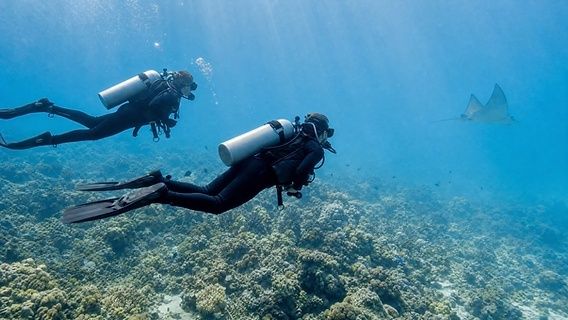
Buddy spacing in a fast pass requires a balance between closeness and fin clearance. Too much distance invites separation when visibility changes or the current accelerates. Too little distance creates collisions, bubbles in the face, and tangled hoses or lines. A side-by-side or slightly staggered formation is often easier to maintain than a strict line, provided every diver understands the reference position and the direction of travel.
Before entry, assign roles. One diver may handle the DSMB and spool while another maintains the primary navigation reference and monitors the group”s position relative to the channel. These roles should not become rigid if conditions change, but they prevent several divers from trying to deploy equipment at once. The navigator should watch the team and the environment, while the reel handler concentrates on line, buoyancy, and the deployment sequence.
- Use a clear, deliberate hand signal for “slow,” “stop,” “turn,” “ascend,” and “problem.”
- Make signals large enough to be seen through bubbles, low visibility, and changing light.
- Use a torch to illuminate hand signals in dim water, but avoid shining it directly into a buddy”s eyes.
- Confirm important signals with an unmistakable response rather than assuming they were understood.
- Regroup at agreed locations, such as a depth band, reef margin, or after a major current transition.
- Follow the boat and guide”s separation, lost-buddy, and surface-pickup procedures without improvising.
High-flow teams also need a surface plan that is as specific as the underwater plan. The skipper should know the expected direction and approximate route of drift, while the divers should know what to do if the group separates or a DSMB fails to appear. National maritime safety guidance, including the authoritative maritime safety guidance, reinforces the value of visible signaling, organized operations, and accountability on the water.
At the surface, positive buoyancy comes first. Inflate the buoyancy compensator, keep the DSMB visible, and establish contact with the boat only when the sea state and traffic make it appropriate. Do not descend again merely to search for a separated diver unless that action is part of a trained and briefed emergency plan. The safest team is not the one that appears fearless; it is the one that follows limits, communicates early, and keeps every diver locatable.
Stepping Aboard with Confidence and Coastal Poise
The final safety stop is another active phase of a drift dive. Stay within the planned depth range, maintain controlled line tension, and keep the team close enough to communicate without crowding one another. The DSMB should remain visible and appropriately managed, while each diver monitors gas, depth, buoyancy, and the direction of travel. A safety stop is not a time to become passive, especially when the current is still moving the group toward the pickup area.
After the stop, ascend in a controlled manner, establish positive buoyancy, and keep the surface marker visible. Once on the surface, signal clearly, remain together, and follow the boat crew”s pickup instructions. The final reward is not simply the rush of being carried through a reef cut. It is the calm that follows a well-managed dive, when every diver has contributed to turning powerful moving water into a coordinated, exhilarating passage.
High-energy drift diving is best understood as a dialogue with the sea. Read the current before entering it, manage friction instead of fighting the line, deploy the DSMB with patience, and protect the team through clear roles and signals. With suitable training, conservative planning, and respect for local conditions, the tidal pass becomes less a force to endure and more a moving landscape to navigate with confidence.